Yearly Archives: 2018
13 posts

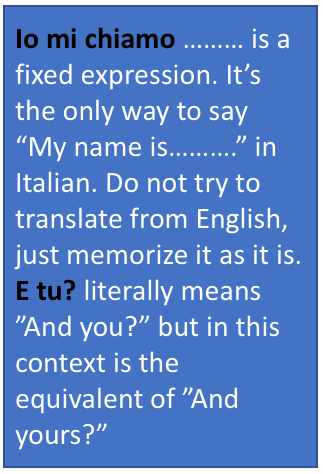
Tell your name Listen to it Io mi chiamo … My name is … E tu? And yours? Io is never capitalized unless it begins a sentence: Ciao, io mi chiamo David (Hi, my name David) VS Io mi chiamo Venere (My name is Venus) After introducing yourself, you can ask the other person […]
TABLE ONE this is cell one this is cell two this is cell three this is cell four TABLE TWO this is cell one align left and a little padding this is cell two align left and a little padding this is cell three align left and a little padding […]

test test [gravityform id=”4″ title=”true” description=”true”] [popup]popmake-998[/popup] popmake-998 [su_table] Table Table[su_box title=”Curiosity” box_color=”#0000FF” title_color=”#ffffff” radius=”2″]Curiosity After a relationship progresses, it is common in Italy to be invited to switch from the formal to the informal way to address each other. «Possiamo darci del ‘tu’?» which figuratively means […]
‘Where are you from?’ How do ask this question in Italian? You have two options: Di dove sei? (informal) or Di dov’è? (formal). How do answer it? Italians do not used the construction ‘I am from +country of origin’, but Io sono + the adjective of nationality: Io sono italiano (“I am […]
Titles are generally used when addressing people in a formal way. You can use signore for a man or signora for woman followed by the surname. Some professionals are usually addressed by their professional titles such as professore / professoressa, dottore / dottoressa, ingegnere, and avvocato. [table id=13 /] Titles ending […]
As said in a previous chapter the formal the word lei can be written with the capital letter for the formal pronoun (you formal), but this is an artificial distinction less and less common. In everyday situations such as newspaper interviews, and dialogues in fictional writing, the formal pronoun is in fact written […]

